Construction has one of the highest injury rates of any industry in the United States. According to OSHA, the “Fatal Four” – falls, struck-by incidents, electrocutions, and caught-in/between hazards – account for more than half of all construction worker deaths each year. And yet, most construction companies still train workers the same way they did 30 years ago: a stack of papers, a checklist, and maybe a video.
That is changing. The companies building the next generation of training programs are not replacing their instructors. They are equipping them with better tools, starting with immersive VR eLearning.
The Problem with Traditional Construction Training
Paper-based and video-based training is cheap to produce and easy to scale, but it has a fundamental weakness: passive learning does not stick. Workers watch a video about fall protection, sign a form confirming they watched it, and move on. A month later, they are 30 feet up on a scaffold and the habits they need have not been built.
Research consistently shows that people retain information far better when they practice a skill, not just observe it. For construction, this creates a real tension. You cannot let a new hire practice operating an excavator near a utility line until they know what they are doing. You cannot recreate a confined-space emergency in a training room. The scenarios that matter most are the ones that are hardest to practice safely.
That is exactly the gap VR eLearning fills.
What VR Training Looks Like on the Job Site
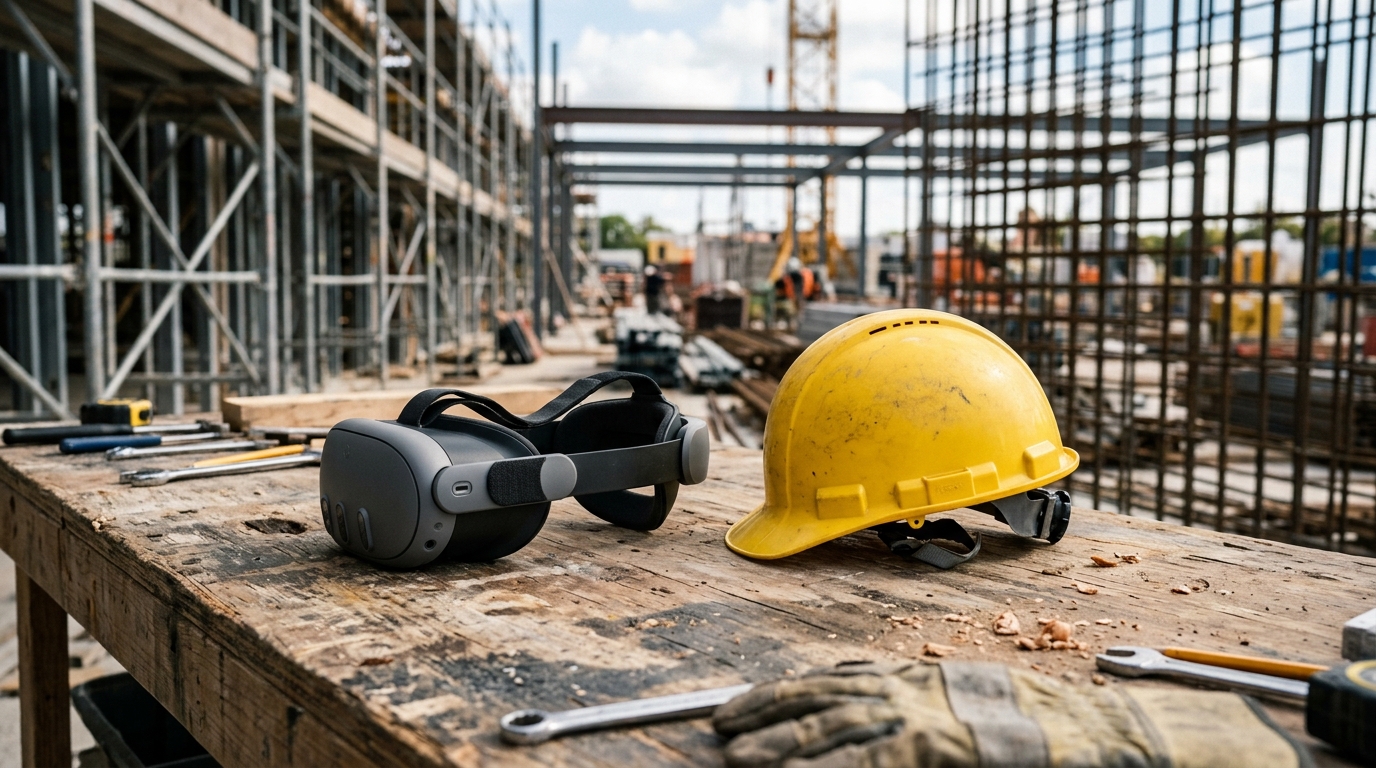
Modern VR training for construction is not a game or a novelty. It is a structured eLearning environment where workers move through realistic simulations of the exact tasks they will perform in the field. A worker can practice identifying fall hazards on a virtual job site before they ever set foot on a real one. A crew can run through the steps of a confined-space entry procedure, make mistakes, see the consequences, and repeat it until the sequence is automatic.
The key distinction from a classroom exercise is presence. In a VR environment, your brain registers the experience as real in a way that watching a screen does not trigger. You look down from a virtual scaffold edge and your body responds to the height. That physical response is part of how memory and habit form.
For construction specifically, VR training is well suited to several high-stakes scenarios.
Fall Protection and Scaffolding Safety
Workers can practice identifying improperly rigged scaffolding, walk through proper tie-off sequences, and experience the visual cues of an unstable platform – all without any physical risk.
Heavy Equipment Operation
Operators can learn the sight lines, blind spots, and swing radius of equipment in a simulated environment before their first real session. This reduces the risk of struck-by incidents, which are the second leading cause of construction fatalities.
Confined Space Entry
The permit-required confined space procedure is one of the most procedurally complex tasks in construction. VR allows workers to run through the full sequence repeatedly: atmospheric testing, communication protocols, rescue planning. Each repetition builds the kind of automatic recall that holds under pressure.
Hazard Recognition
Job site walkthroughs in VR can include embedded hazards that workers must identify and flag. This trains the habit of active observation rather than just task completion.
Why eLearning Structure Matters
VR is a powerful training modality, but it works best when it is embedded in a complete eLearning system – not deployed as a standalone experience. The most effective construction training programs pair VR simulations with structured eLearning modules that provide the foundational knowledge workers need before they enter the simulation, and track comprehension and performance after.
This means pre-work modules that establish regulatory context, terminology, and procedure steps. It means VR simulations that put that knowledge into practice in realistic scenarios. Post-simulation assessments that measure retention and flag gaps. Completion tracking that satisfies OSHA recordkeeping and audit requirements.
The result is a training program that is more defensible from a compliance standpoint and more effective at actually building safe behavior.
The Business Case for Construction Companies
The argument for VR eLearning is not purely about safety, though that is the most important part. There is also a significant operational and financial case.
Worker turnover in construction is high. The average construction firm hires and onboards multiple new employees every year, and each one requires the same core safety training. A well-built eLearning program with VR components can deliver that training consistently at scale, without requiring a senior employee to run the same session repeatedly. Onboarding becomes faster and more standardized.
There is also an insurance angle. Carriers increasingly ask about training programs during underwriting. A documented eLearning system with completion records and assessment scores is a meaningful differentiator from a company that relies on sign-off sheets.
And for contractors pursuing federal work – particularly in defense or government construction – demonstrable training programs can be a factor in contract qualification.
Getting Started
The barrier to entry for VR eLearning is lower than most companies expect. The equipment cost for a fleet of VR headsets has dropped substantially in recent years. More importantly, purpose-built eLearning platforms now support VR content alongside traditional modules, so you do not need to build a separate system.
What does require investment is the design and development work: mapping your training requirements to scenarios, building content that reflects your actual job site conditions and procedures, and structuring the assessment logic. That is where working with an experienced eLearning development partner makes a measurable difference.
The companies getting the most out of VR training are not the ones with the largest budgets. They are the ones that started with a specific high-risk scenario, built a focused simulation around it, measured the results, and expanded from there.
Building a Training Program That Works
If you run a construction company and your current training program relies on the same materials it did five years ago, this is a good time to look at what is available now. The tools have matured, the costs have come down, and the stakes of inadequate training have not changed.
Sutter Group designs and builds eLearning programs for organizations that need training to actually work, not just satisfy a compliance checkbox. If you are exploring what a VR-integrated training program could look like for your crew, we would be glad to talk through it.