Sutter Group
AR Product Visualization | Try-Before-You-Buy
AR product visualization that lets customers experience your products before they buy, improving conversion and reducing returns.
Sutter Group
AR product visualization that lets customers experience your products before they buy, improving conversion and reducing returns.
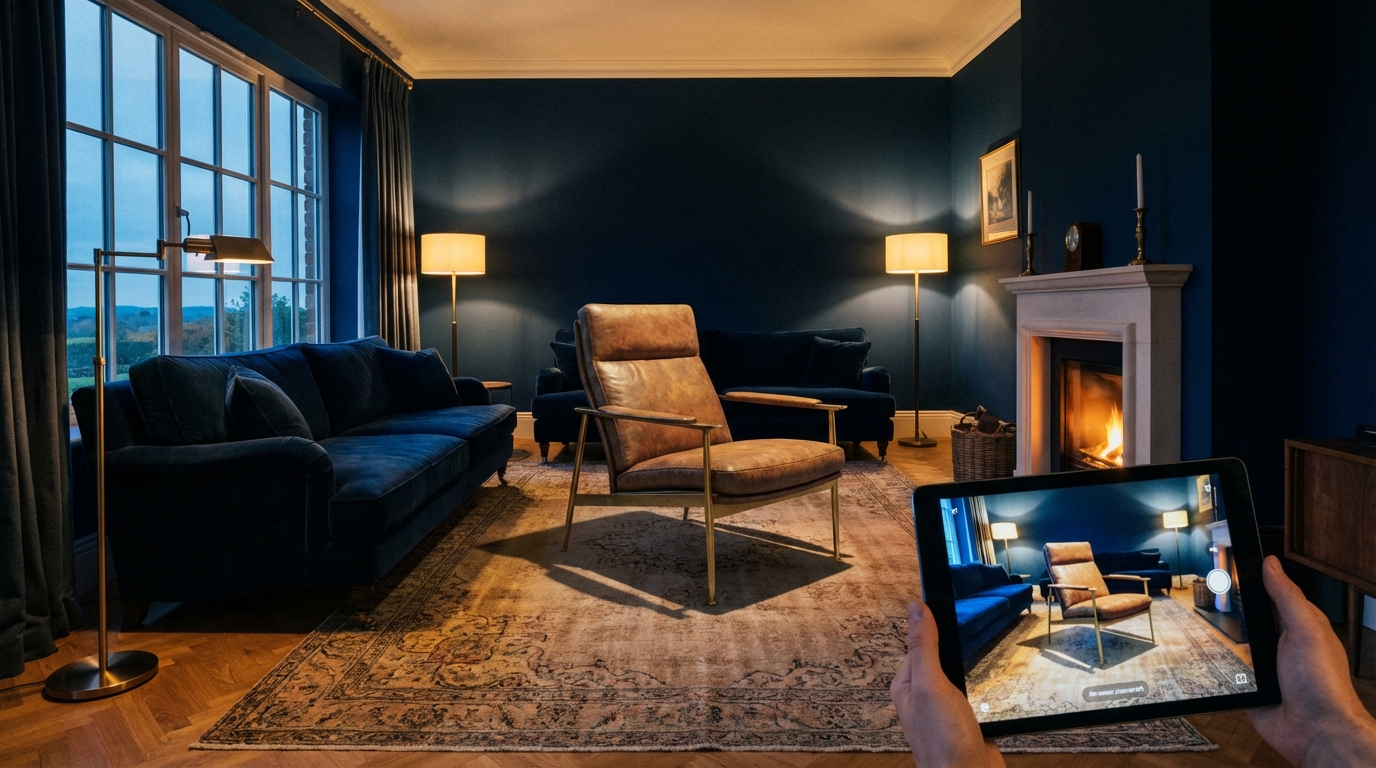
When customers can visualize a product in their actual environment, on their body, or in the context of their life before purchasing, conversion rates improve dramatically and return rates drop. AR product visualization makes this possible at scale, giving every customer the equivalent of a personalized showroom experience without the showroom. The data consistently shows that AR visualization increases purchase confidence and reduces purchase hesitation for complex or high-consideration products.
Sutter Group builds AR product visualization experiences for manufacturers, retailers, and brands that sell products where the customer’s ability to imagine the product in their specific context is the primary barrier to conversion. We work across product categories from furniture and interior fixtures to industrial equipment, consumer goods, and branded merchandise.
High-quality AR visualization starts with high-quality 3D assets. We work from your existing CAD files, technical drawings, or physical product samples to develop photorealistic 3D models that accurately represent materials, finishes, dimensions, and configurations. Asset quality is the primary determinant of visualization believability, and believability is what drives the conversion lift that justifies the investment.
Browser-based AR product visualization removes the app download barrier that limits adoption of native AR applications. Customers point their phone camera at the target environment, tap to place your product, and see it at accurate scale in their real space without downloading anything. WebAR experiences can be embedded in your product pages, shared via QR code in print materials, or deployed as standalone landing pages for campaign-specific products.
For brands with existing mobile applications or for product lines where a dedicated app experience is justified by purchase frequency or configuration complexity, we develop native AR visualization modules for iOS and Android. Native AR offers richer interaction models, more reliable tracking, and tighter integration with product catalogs, configurators, and e-commerce systems than browser-based alternatives.
Complex products with multiple material, color, or configuration options benefit from AR visualization combined with a configuration interface. Customers can change finishes, swap components, adjust dimensions, and see each variation in their actual environment before committing to a configuration. For manufacturers of customizable products, this dramatically reduces the back-and-forth between the customer and the sales team during the specification process.
Physical retail locations and showrooms can use AR to extend the range of products available for customer visualization beyond what can be physically stocked or displayed. A furniture showroom with floor space for fifty pieces can offer visualization for five hundred using AR kiosks or customer-facing tablet experiences. The showroom becomes a starting point for exploration rather than a constraint on the customer’s imagination.
The business case for AR product visualization has been demonstrated across categories and retail formats. Reduced returns represent direct cost savings that often fund the visualization investment within months of deployment. Increased conversion rates on product pages with AR visualization versus those without are consistently measurable. Average order values frequently increase when customers can visualize premium configurations and finishes in their actual space.
The investment required for AR product visualization has decreased significantly as the technology has matured. For brands selling products in the $200-and-above consideration range, the math typically works in favor of AR visualization even at modest traffic levels.
The right starting point depends on your product catalog, your existing digital asset library, and the primary channel where your customers research and purchase. We assess these factors and recommend a phased approach that delivers measurable results from the first deployment while building the asset and platform foundation for broader rollout.
The moment a customer can place your product in their actual environment and see it at real scale, the nature of the purchase decision changes. Doubt about whether the dimensions work in the space is eliminated. Uncertainty about how finishes or colors will look in actual light conditions is resolved. The cognitive effort required to imagine the product in context is removed entirely. These reductions in purchase friction are what drive the conversion lift that AR product visualization consistently produces. For brands selling products where visualization doubt is a significant barrier to conversion, the return on AR visualization investment is among the most predictable in the digital toolkit. We help organizations identify where that barrier is highest and design AR visualization experiences that address it directly.
Contact us to talk about AR product visualization for your product line.
From Our Practice
AR product visualization works best when it is integrated into a broader digital experience. Explore our Virtual & Augmented Reality service for the full immersive scope, or see Web Design & Development for how web and digital platforms host and deliver AR content. Read Creative Intelligence: The Strategic Edge Most Brands Are Missing for our perspective on how emerging creative technologies build brand advantage.
From Our Insights
Let's Talk
Tell us about your project. We respond within 24 hours.