Sutter Group
Mixed Reality Experiences | HoloLens & Spatial Computing
Mixed reality experiences that blend physical and digital environments for next-generation brand and training applications.
Sutter Group
Mixed reality experiences that blend physical and digital environments for next-generation brand and training applications.
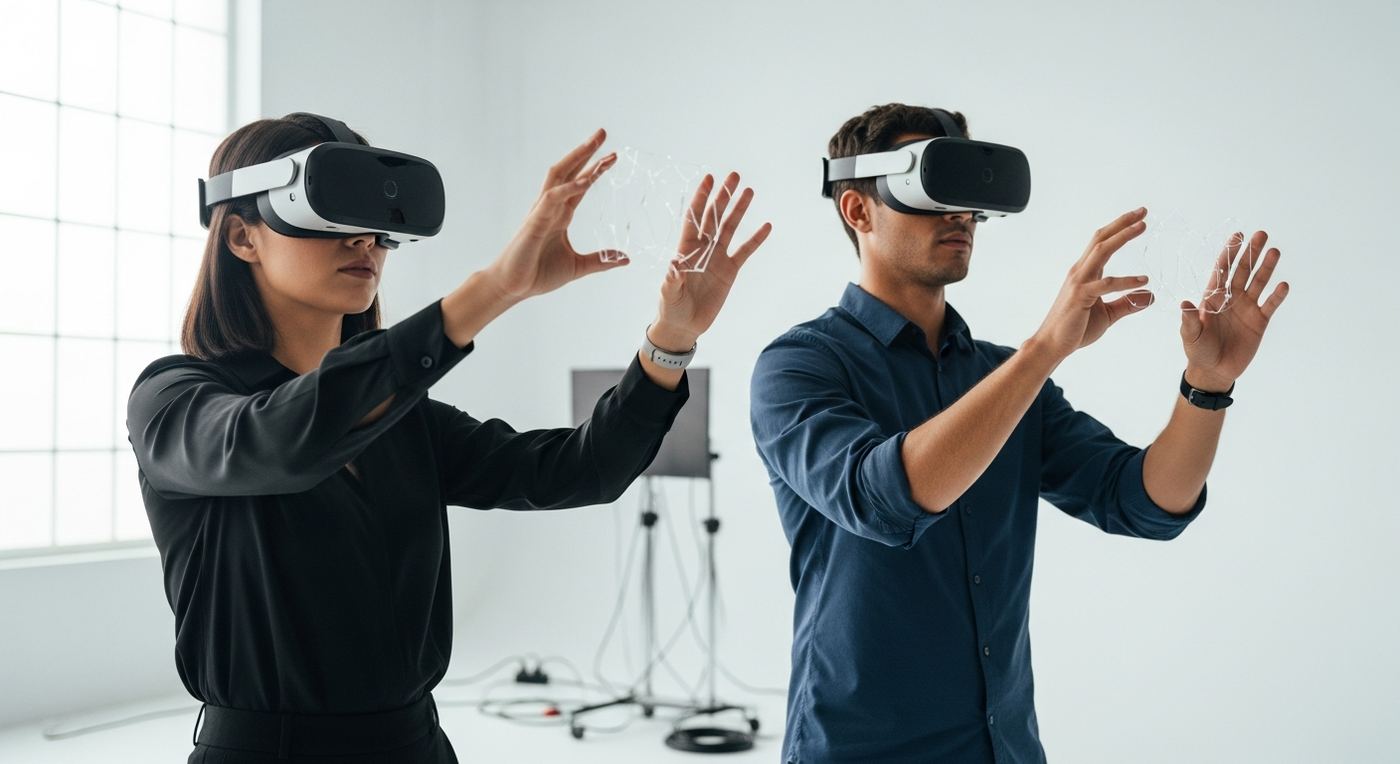
Mixed reality blends physical and digital environments in ways that pure VR and AR cannot achieve. Rather than replacing the real world or overlaying graphics on a camera feed, MR devices understand the geometry of real spaces and anchor digital content to physical surfaces, objects, and locations with precision that holds up as users move through an environment. The result is a class of experience where digital and physical feel genuinely integrated rather than superimposed, opening design possibilities that neither medium offers alone.
Sutter Group creates mixed reality experiences for organizations in the DC, Maryland, and Virginia region that want to explore what MR can do for their training, collaboration, visualization, and audience engagement objectives. We design and develop across the leading MR platforms and bring both the technical capability and the design discipline that determine whether an MR experience actually works for real users in real environments.
Mixed reality requires a design approach that differs fundamentally from both traditional screen-based interface design and pure VR design. The real environment is part of the canvas, and that environment varies in ways that must be anticipated and accommodated. We design MR experiences with spatial UX principles that respect how users move through and interact with real space, using digital content to enhance the physical environment rather than fight it. Experiences that feel designed for the specific context where they will be used are experiences that users trust and adopt.
Mixed reality delivers measurable value in enterprise contexts where workers need to collaborate across distances or access expertise in real time while keeping their hands free. Remote assistance applications that allow an expert to see what a field technician sees and annotate their physical environment with guidance, collaborative design review where distributed teams can examine shared 3D models as if they were physically present together, and real-time data overlay on physical equipment are all applications we develop for enterprise organizations in the Mid-Atlantic region.
Mixed reality training combines the contextual authenticity of the real environment with the safety, repeatability, and guidance capabilities of synthetic overlays. Trainees work with actual equipment or in actual environments while receiving step-by-step procedural guidance, performance feedback, and access to reference information overlaid on the real objects and spaces they are working with. This combination of real-world context and digital support produces training transfer that pure simulation cannot match because the skills developed in training are anchored to the actual environment where they will be applied.
Complex data that is difficult to understand in charts and dashboards can be made immediately intuitive when visualized in three-dimensional space at the scale of real environments. Architectural and infrastructure data overlaid on physical sites, operational metrics visualized within the facilities they represent, and analytical models anchored to the geographic areas they describe are all applications of spatial data visualization that MR enables. For organizations dealing with complex spatial data, this can transform decision-making by making the data legible in a way that 2D representations cannot.
Museums, cultural institutions, government agencies, and associations in the DC region use mixed reality to create public engagement experiences that communicate complex or abstract subjects through direct interaction. Historical environments overlaid on physical sites, scientific concepts visualized at human scale, and interactive exhibits that respond to visitor presence and movement are among the engagement applications we develop for institutional clients in this market.
The mixed reality hardware landscape is anchored by Microsoft HoloLens 2 for hands-free professional applications and Meta Quest Pro for experiences where all-day wearability is less critical than rich interaction. We develop for both platforms and advise on platform selection based on the specific use case, environment, user workflow, and budget parameters of each project. Platform decisions made early determine what the experience can ultimately do, making the selection process one of the most consequential early decisions in any MR project.
Most organizations that engage us for mixed reality work are at an early stage of understanding what MR can do for their specific context. We start with a discovery process that maps your objectives to MR capabilities, identifies the applications with the clearest value and the most realistic path to adoption, and develops a phased approach that delivers early demonstrable value while building toward more ambitious long-term applications.
Contact us to discuss mixed reality experiences for your organization.
From Our Practice
Mixed reality combines the best of AR and VR into a single cohesive experience. Explore our Virtual & Augmented Reality service for the full scope of immersive technology work, or see Visual Storytelling for how visual storytelling principles apply to spatial environments. Our work with Areté shows how we approach immersive technology for professional audiences.
From Our Insights
Let's Talk
Tell us about your project. We respond within 24 hours.